
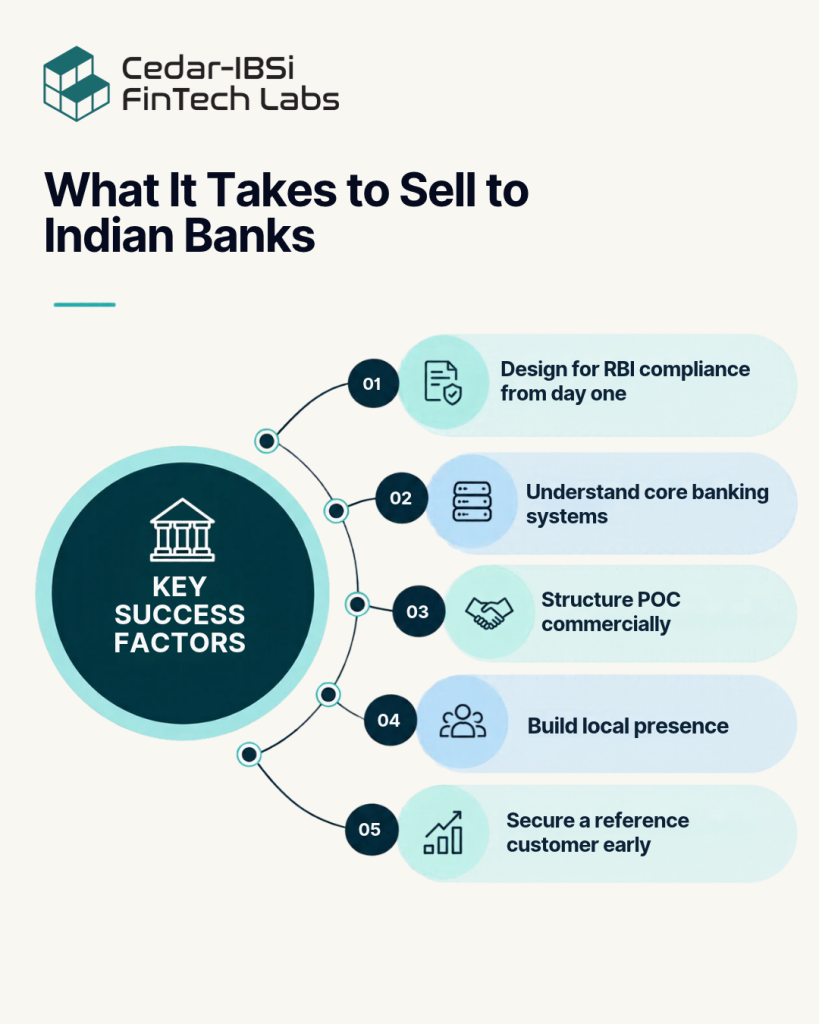
India’s enterprise fintech market is projected to reach $20 billion by 2030 (Chiratae Ventures and The Digital Fifth, 2024). The country has the highest fintech adoption rate among major economies at 87% (Anantamias, 2026). The opportunity is real but building a B2B FinTech that Indian banks will actually deploy, not just pilot, is a separate challenge entirely. Having supported 70+ FinTechs through India market entry at Cedar-IBSi FinTech Lab, these are the five things that separate the ones that close from the ones that stay in POC forever.
Design for RBI Compliance Before You Build the Sales Deck
RBI compliance is not something a global FinTech can retrofit after building the product. India’s banking regulator has specific expectations on data residency, outsourcing agreements, model governance, and third-party risk audits. Indian bank risk and IT committees will not approve a vendor unless compliance evidence is embedded in the product architecture — not added as a wrapper. Build it in from day one or prepare for a long wait.
Know Your Core Banking System Before the First Meeting
India’s largest banks run on Finacle, BaNCS, and FinnOne. Understanding how your product integrates with these systems — API depth, data exchange format, on-premise versus cloud constraints — is the question most Indian bank CTOs ask in the first meeting. A FinTech that cannot answer it specifically will not get a second one. Arrive with integration documentation, not a demo.
Structure the POC Commercially — Not as a Free Trial
One of the most common mistakes global FinTechs make is offering a free proof-of-concept. Indian banks run dozens of concurrent POCs. A zero-cost pilot signals low confidence in your product’s ROI and rarely has a named internal sponsor. Structure your POC with a commercial framework — a defined success metric, an expansion clause, and a nominal fee that forces the bank to assign ownership.
Build Local Presence Before You Need It
Indian banks will not sign a multi-year contract with a vendor who has no local presence. A local account manager, support capacity in the same time zone, and a named point of contact signal that you are a long-term partner, not an opportunistic pilot. Presence matters more than you expect in a relationship-led market.
Your First Reference Customer Is Your Most Valuable Asset
In India’s BFSI market, one successful deployment does more selling than your entire outbound strategy. Indian bank technology heads speak to each other. A referenceable production deployment at one mid-tier private bank opens conversations with three others. In year one, prioritise a successful reference over scaling revenue. It compounds faster than anything else you will do.
Expanding into India’s banking market? Cedar-IBSi FinTech Lab has supported 70+ B2B FinTechs through this journey — from first bank introduction to signed contract. Express your interest