
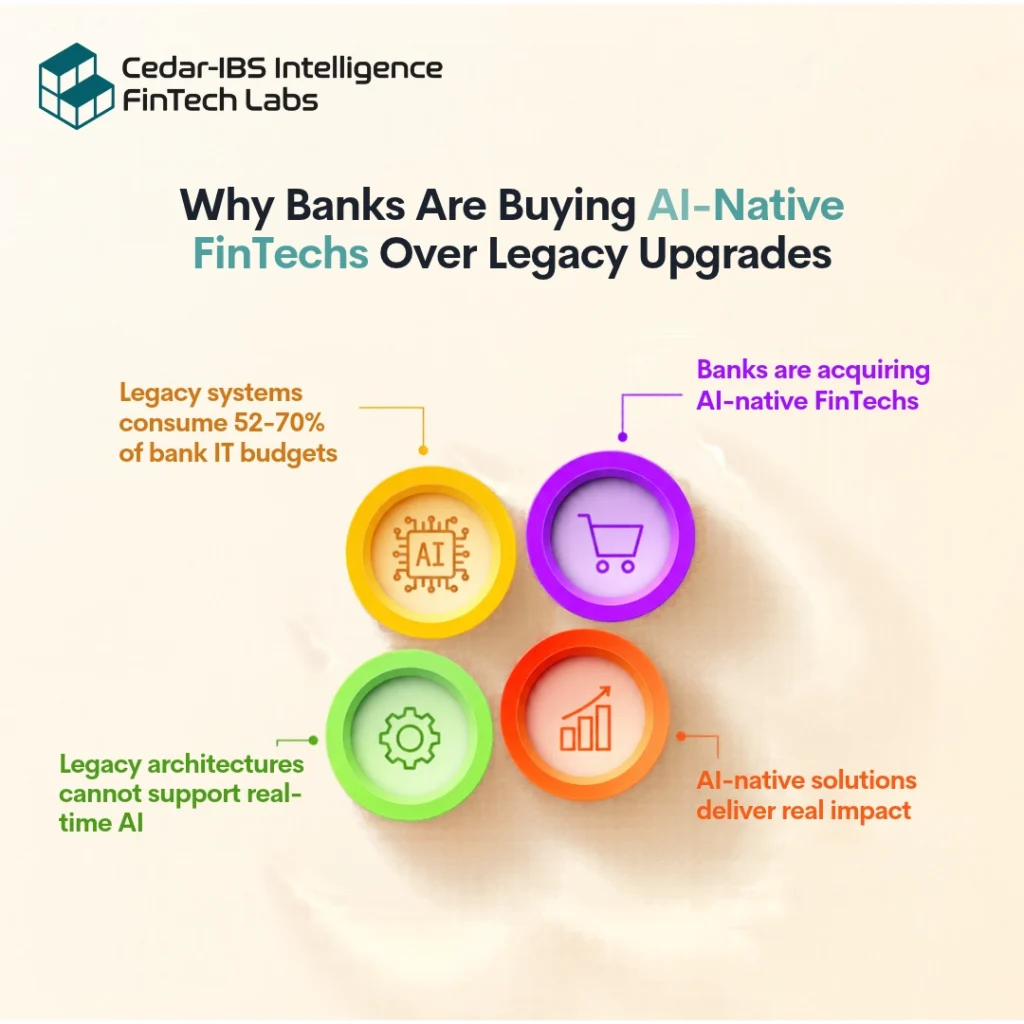
Nearly 70% of bank IT budgets are consumed simply by maintaining legacy systems – leaving little room to innovate (Orbograph, 2026). In 2026, banks are responding not by upgrading what they have, but by acquiring what they cannot build fast enough: AI-native FinTechs that operate as modular intelligence layers alongside existing infrastructure.
Why the Legacy Upgrade Path Has Stopped Working
Layering AI onto decades-old core systems produces the same result every time: expensive pilots that never reach production. Legacy architectures built for batch processing and deterministic workflows cannot support real-time inference, continuous model retraining, or automated audit trails. Between 52% and 70% of bank IT budgets are already consumed by keeping these systems operational leaving AI adoption structurally underfunded before a single model is trained (GFT, 2026).
What the Market Is Telling Us in 2026
The procurement shift is now visible in M&A. In early 2026, FIS – one of the world’s largest core banking providers acquired AI-native startup OpenCoreOS just months after its launch. “Six years after launching its own modern banking platform, FIS went out and bought an AI-native core,” noted Paul Schaus of CCG Catalyst (The FinTech Times, 2026). Barclays took a strategic stake in United Fintech. Temenos acquired Zurich-based additiv for AI-powered wealth orchestration (Dealroom, 2026). These are not isolated deals. They signal that the AI-native layer cannot be retrofitted from legacy infrastructure it must be bought in.
What AI-Native Actually Means in a Procurement Context
An AI-native FinTech is not simply one that uses machine learning. It is built from the ground up to support probabilistic outputs, real-time data flows, and continuous model governance designed to co-exist with a bank’s existing core as an intelligence layer rather than a replacement (Avasant, 2026). This is the architecture banks’ procurement committees are now explicitly evaluating.
What This Means for B2B FinTechs Entering the Banking Market
Banks are actively building vendor shortlists for AI-native capabilities across credit underwriting, fraud detection, compliance automation, and customer intelligence all areas where legacy vendors have no credible roadmap. For B2B FinTechs with the right architecture, the procurement window is open now, before the shortlists close. At Cedar-IBSi FinTech Lab, 70+ member companies have navigated exactly this transition securing their first bank deployments at the moment procurement priorities shifted.
Building an AI-native FinTech for the banking market? Express your interest and tell us what you are building.