
March 18, 2026
Nearly two decades after the 2008 financial crisis, financial regulation continues to evolve. What changed was not just the rules, but how financial institutions manage them.
Risk management moved from a specialist function to a board-level priority. Regulatory oversight also shifted from periodic reviews to continuous monitoring. Today, banks and financial institutions must manage compliance every day across their operations.
This is where RegTech, or Regulatory Technology, plays a critical role.
What is RegTech?
RegTech uses technology to help financial institutions manage compliance, monitor risk, and meet regulatory requirements more efficiently. Recent industry explainers from McKinsey and DFIN describe RegTech as technology that improves financial-services risk and compliance processes, and as a subset of FinTech focused on simplifying regulatory compliance.
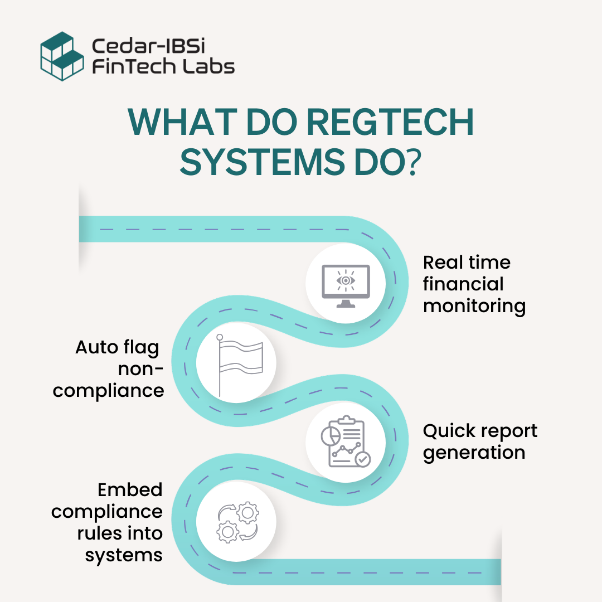
Instead of relying on manual processes, RegTech systems:
- Monitor financial activity in real time
- Automatically flag suspicious or non-compliant transactions
- Generate regulatory reports quickly and accurately
- Embed compliance rules directly into business systems
This allows organisations to move from reactive compliance to proactive risk management.
RegTech vs FinTech
RegTech is often discussed alongside FinTech, but it’s important to understand that RegTech is a subset of FinTech. While both are integral to the financial technology ecosystem, they serve different purposes:
- FinTech focuses on innovation, creating new financial products and digital services that transform the way financial services are delivered to consumers and businesses.
- RegTech, on the other hand, ensures these innovations operate safely and in line with regulatory standards. It uses technology to automate compliance processes, monitor risk, and support real-time reporting. This positioning of RegTech within FinTech is consistent with recent industry definitions.
As financial services continue to digitise and become more global, regulatory complexity is increasing. This is driving growing demand for RegTech solutions that help businesses maintain compliance while scaling and innovating across multiple regulatory environments.
A Fast-Growing Market
The global RegTech market reflects this shift.
- Market size in 2025: $19.6 billion
- Expected market size by 2032: $83 billion
- Estimated 22.8% CAGR
This growth highlights how important regulatory technology has become in modern financial services.
The Infrastructure Behind FinTech Growth
At organisations like Cedar-IBSi FinTech Lab, experience shows that the most successful financial institutions treat compliance as core infrastructure, not a barrier.
Like cloud platforms or cybersecurity systems, RegTech works quietly in the background—helping institutions scale, innovate, and maintain trust. As financial services continue to digitise, RegTech will remain the quiet engine powering sustainable FinTech growth.